

All about Rick and His Wooden Birds
When Labrador Quarterly Staffer, Terry Swanson received her hand carved Pintail Drake, she thought readers might enjoy learning a bit more about the artist, Rick Mignano and the process of creating a lifelike Wooden Bird. Rick Mignano is a decorative duck carver living in Barrington, IL., a northwest suburb of Chicago, IL.

Decoys
The first decoys were made by Native American Hunters because they knew that birds attract other birds. Later pioneers began carving duck decoys from wood. By mid 19th century, the carving of decoys evolved into an art form and today carving is 90% decorative. These decorative ducks are more realistic and intricate and are more likely to be seen on display shelves rather than on the water.
In the beginning…
In 1981, my wife and I were walking by a small shop, Wings & Things, in historic Long Grove, IL. When we opened the door we were greeted by the shop owner’s big, yellow lab. Being a long time Lab lover that was treat enough, but the next thing that caught my attention was the collection of wooden ducks that looked so real I wanted to touch them. I was intrigued! I made several more visits to talk with t
he owner, Bob Lis, a nationally known carver, to learn about this magical art form of carving realistic, life-sized wooden ducks.
As a Christmas gift that year, I received the book, “Game Bird Carving”, by Bruce Burk, and a blank duck body. I read the book and took a class with Richard LeMaster, an early master of the craft, and I was hooked. That was my entry into the wonderful world of decorative duck carving. For the next 5 years I worked on my craft and carved about 25 ducks. Family and friends were the main recipients and I kept many of them. But by 1987 my life became busier – I began building a new home in the woods, and my family and career left no time for Wooden Birds. The paints, tools and books were put in boxes.
Fast forward 28 years and I was newly retired. I believe my wife was worried that if I didn’t find a hobby, I would start alphabetizing the spice bottles. She unpacked some of my original duck carvings, and put them on some shelves to display, hoping they would pique my interest again. Seeing them, I could smell the sawdust and heard all my old tools calling my name. It wasn’t quite like hopping back on a bicycle, but as time passed, I found my groove and with each project, my skills improved.
That was 10 years ago and you can now find me in my workshop, most every day in our walkout basement. There are two sliding doors looking out into our woods. My assistant, Kava Bean, our 5th

chocolate lab enjoys her special spot under my workbench where she keeps an eye on the squirrels and deer outside. She doesn’t mind that she ends up with a layer of sawdust on her head when it’s time to head upstairs for dinner.
But how does a block of wood turn into Duck?
Creating a decorative duck requires two rather different art forms; sculpture and painting. Each project begins with researching the bird I want to carve. You can’t make a duck look real if you don’t know what a real duck looks like. I browse books, photos and online sources – the more info I can gain on each bird the better the end product will be. The research shows me the overall look of the bird, feather coloring, eye placement and all the other little quirks of the duck like the tilt of the head or the puffiness of the feathers. I’ve accumulated a database of thousands of photos of the various waterfowl species. I use two computer screens to display photos of the bird I’m working on.
My duck begins with a block of Tupelo or Basswood. These are relatively soft woods with almost no knots or grain. I pencil the duck pattern on the wood then use a band saw to cut it out. N
ext I switch to a heavy type grinder to shape the final body of the duck.
When the basic form has been achieved, I use a variety of Dremel type tools to carve and shape the individual feather groups. The goal is to get those feathers to look realistic. I text
ure every feather and every barb using dental type bits and wood burning. It’s a tedious process but one that creates a natural look. In addition to the feathers, I work on the detail of the bill and the correct placement of the glass eyes, all are critical to bringing the bird to life
Last comes the painting, the finishing touch. I like to say, “putting on the makeup”! I use acrylic paints. Layer upon layer is applied to the feathers. The more thin layers and tiny flicks of color one applies the softer the feathers. For instance, a Mallard Hen is brown. But, it’s actually a pattern of browns, black, tan and whites. To achieve
the natural look, I start with a brown and beige pattern and then add hundreds of lines of dark brown and white on top of that with a fine paintbrush. This process creates feather splits and the end result is a soft and natural looking duck.
The crazy colored Wood Duck drake is a painting challenge in two respects, iridescence & vermiculations. Their iridescence is seen through the feathers on the back and head. To make the iridescence pop, a base coat of yellow or white is applied. Then very thin washes of blue, green and violet iridescent paint are applied with an air brush or by blending the wet colors together with a brush. The Wood Duck’s sides require the second challenge: vermiculations, thousands of tiny dots applied in a pattern to each feather with a fine paint brush or pen. It normally takes me 3 hours to do those patterns. My hands start to shake just thinking about it.
They say a good paint job can improve a bad carving, but a bad paint job will ruin any good carving. Paint gives depth, dimension and softness to the duck and is worth all the time it takes to do it right.
How long does it take?
I’m frequently asked, “How long does it take to make a duck?
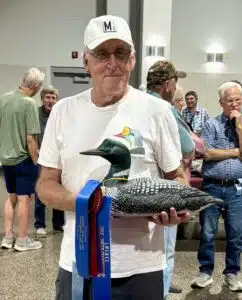 My aim is to have a duck I carve look like it just ‘landed’ on your family room shelf rather than being stiff or artificial. I usually spend 50-80 hours from start to finish, depending on the size and complexity of the bird.
So, I guess the answer would be: It takes as long as it takes to achieve those results.
I’ve participated in various Art and Decoy Shows and my duck entries have been rewarded with 37 ribbons, including (21) 1’st place blue ribbons and (4) Best of Show. Even though my ducks are decorative rather than working decoys – competition rules says they must float in a lifelike manner. Before a show, I take the finished duck for a float test our pond. My assistant Kava Bean seems to enjoy this part of the process the most. She can’t wait to splash around with the ducks.
My return to carving has brought me much joy. When someone commissions one of my ducks, I found that involving them with the process is a Win/Win for both of us. We discuss what duck they want me to carve. I ask questions … which way do you want the head to point? Do you want the hen or drake? Who will be receiving the bird? Throughout the project, I am in communication with them. I email them photos of my progress. It’s like we are working on the bird together.
Duck carving has kept me busy and happy. I have established dozens of new customer friends across the country. My website thewoodenbird.com has brought people to me and my business has grown. I now work exclusively on commission and am typically 6 months out on orders.
I provide a product that doesn’t get returned, thrown out, or sent to Goodwill. My wooden birds will be around long after I’m gone. Likely passed down from generation to generation. In today’s crazy fast paced world, I couldn’t ask for much more than that.
